I’ve had this post titled (but unwritten) and sitting in my WordPress drafts since January of 2022.
You remember…it was the height of Metaverse fever. It was the Next Big Thing(tm) and you were a fool if you weren’t making some sort of play to build “a metaverse.” (have I mentioned I hate it when someone refers to A metaverse…there is only one, there cannot be many, it just…sigh.)
Of course the majority of Metaverse plays were secretly NFT plays as if a web of virtual worlds couldn’t possibly exist without web3 tech. Much of the hype came from the big social network with the big blue app and the guy who renamed his company because the Metaverse was inevitable. He then went on the spend billions trying to build a singular virtual world completely controlled by him. Not the Metaverse.
Meanwhile…real work is being done all over the web to build unique and interesting 3D spaces that will, hopefully, connect. I’ve gone on about this before but for the Metaverse to exist a few things have to happen.
Open Avatar Standards
Open and Accessible 3D worlds
Self hosting
There must be an open avatar standard. We must have the ability to create a 3D representation of us that persists across worlds. You can decide if it looks like you or a giant pink raccoon but that version of you should be able to enter any 3D space without issue. ReadyPlayerMe was the closest but they were recently purchased by Netflix and their services shutdown soon (Jan 31st!). Fortunately, there’s work being done. See the Reference Canonical Skeletal Framework and the KHR Character and Avatar Extension Set.
Any world must be open and easily accessible. I was pretty excited by Mozilla Hubs because it was so easy to launch a world and get started all via the browser. Unfortunately Mozilla abandoned it BUT open sourced the technology so it lives on as the Hubs Foundation. I’m also excited by Arrival.space and what they’re doing with web based 3D spaces but also Gaussian splats all easily experienced, again, in your web browser (both on your computer/phone or in a headset). These spaces must remain accessible from a variety of devices.
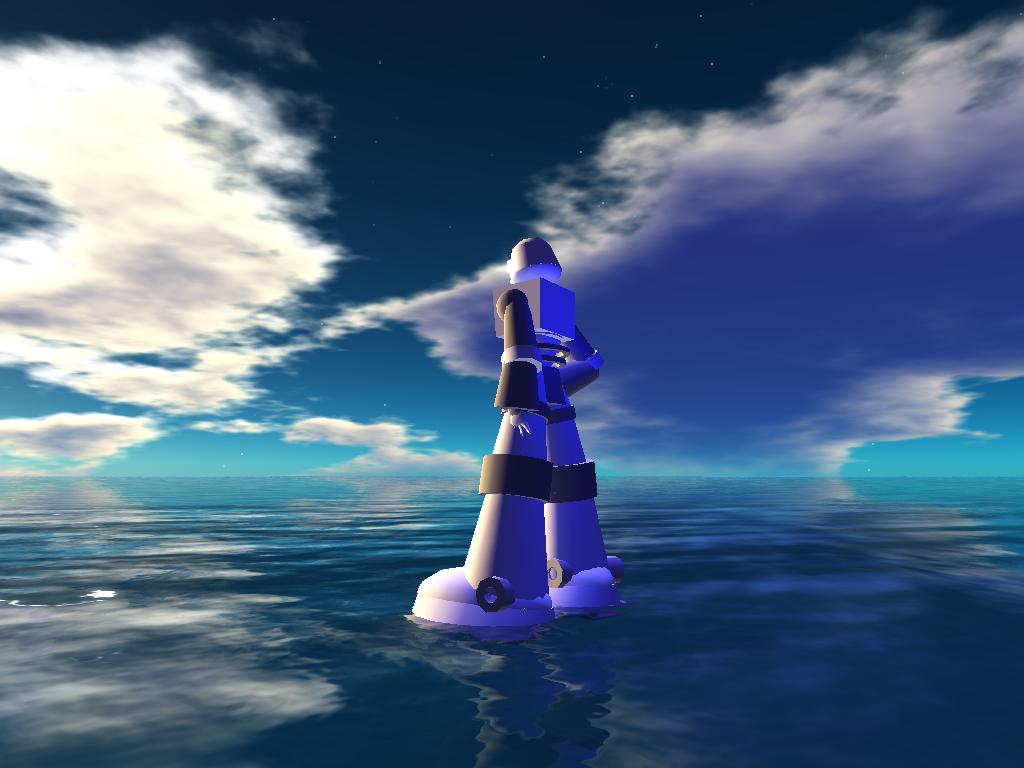
My ReadyPlayerMe (RIP) avatar standing in my Arrival.space running in a desktop browser.
Like the 2D web any of us should be able to host our own space. Many will opt to use a hosting service or a prebuilt world that they customize but the option to build it and host it yourself from the ground up must exist to create a vibrant community of virtual worlds.
I came back to this post with the recent announcements from the guy who renamed his company and the initial feeling that we were, once again, heading for a VR/Metaverse winter. We’re not. Valve has the Steam Frame coming soon. Google, for now (I know I know), is pushing ahead with AndroidXR. Open source tools and game engines are making it easier and easier to build things once and publish to multiple platforms (until standards unite them all!) allowing for rapid experimentation. Organizations like ImmersiveX and the Virtual Worlds Museum (2D site here) are actively building and evangelizing and engaging in multiple worlds.
While I feel for all of those who built something only to have it bought up and then killed and the numerous folks laid off this is likely all better for the greater ecosystem. The giant tech company was taking up a lot of space and now, perhaps, we can grow the Metaverse we want and deserve. There’s still a long road ahead of us but the foundation is being built now.
I’m in the middle of an already long week of IAAPA meetings, gatherings, and sessions in the heart of Florida Vacationland that contrasts starkly to last week’s Immersive X conference that took place entirely in virtual worlds accessed via headset or computer.
Into the Virtual
Immersive X is a 3 day gathering of talks, tours, and social activities held across different platforms for building experiences in virtual worlds. VRChat, Engage, Arrival Space, Spatial io. Each platform chosen for its strengths and set of tools that best serve the hosted session. Attendees dressed as humans wearing human things but also as raccoons, Chile peppers, tiny foxes, robots, and more! This is all expected in the virtual world and thus having a conversation with a robot about art inspired by Arabic writing is perfectly mundane (in the best sense of the word).
The sessions covered a variety of topics across art technology, humanity, and social well being. The schedule was packed tight and, as with any good conference, there was no way to attend every session. Here’s a screenshot of the sessions I planned to joined:
Over the course of 3 days I was able to continue working and continue being with the family while dipping into a scheduled session for 45 minutes at a time. After the first few talks I began to recognize familiar avatars from previous talks noting who was interested in similar topics. Unfortunately I didn’t prioritize any of the social gatherings so I had little opportunity to chat with other attendees outside of the sessions.
Two of the standouts (of the talks I attended) involved building a world for an artist’s work and another for creating venues for live music and gathering.
During the Ink Never Dies session we were guided through a world built to represent ancient Arabia. As you walk through the world golden Arabic characters appear before you as the artist’s voice fills the air to speak about their art and the influence of Arabic culture.
Arabic calligraphy hovering among sparkly particles
The world is still active and you can visit it at any time: (and you should) Vertical Horizon
The Show Must Go On began as a more traditional talk in an amphitheater but then led to world hop where we could experience some of the venues that were created for live music performance.
An amphitheater and audience during The Show Must Go On presentation at Immersive X 2025
Each world was purpose built for a musical artist to fit their style and aesthetic. The spaces live on after the live performance with a recording that plays and can be enjoyed any time.
A world built for Jean-Michel Jarre as an homage to Pierre Henry.
My favorite venue was Oxymore (named for the album) and, as we learned, there were custom avatars created for the live performance so the guests could dress to match the world. VRROOM built this world for Jean-Michel Jarre to perform an homage to Pierre Henry.
Back to the “Real”
IAAPA is a week long conference for the theme park, attractions, etc industry that takes place at the Orange County Convention Center in Orlando, FL. So there I was, in Orlando, FL at IAAPA, (I had actually started writing this in the middle of IAAPA but I’m only finishing it up now) among people dressed as people to convince each other that they are trustworthy and safe to work with. The week packed with meetings, gatherings, and sessions to attend because a lot of money was spent to be there and thus every minute should be filled to justify the expense. This is the way of the business conference.
A glimpse of my calendar from IAAPA week. Details blurred to protect the innocent.
Like any industry gathering you are presenting your best self all day to everyone and anyone. There are brief breaks and maybe you can find a corner where you can stop smiling for a minute but for the most part you are engaged and hyper aware of how to present yourself. Then a quick change of clothes and off you go to a party or demo where you continue until late in the evening. You drink a little but not too much (you hope) you chat, you laugh, you recount that one time that project went horribly wrong but then in the end you made it work. Then you go to bed and wake up and do it again. Even the extroverts are exhausted after a couple of days of this.
Photo from “The Winning Formula” session at IAAPA 2025
But we keep doing it because being in a physical space with other people is still hard to replace.
Addition not Substitution
This is not about which is experience is better. They both have reasons for being and they are both valid and worthwhile. Humans have evolved to exist together in physical space and replicating that to any level of success is quite a feat.
There is a comfort in the casual pace of the virtual conference. I’m not rushing to be anywhere, there’s no travel time, no crowd to push through. I put the headset on (or just load up the world on the computer) and teleport to the venue. If I’m early I can chat with others and find a seat, or stand (my avatar can stand forever). My avatar handles the presentation of me. I don’t feel pressure to put on appearances. I can sit comfortably in any room of the house. I can enjoy and absorb the content in a manner that suits me at the moment. When the presentation is done, more often than not, the presenter can open a portal to the very project or world they have discussed and we can all hop through and experience it instantly. When I’m ready, I hop to the next one or jump out and take care of work, or lunch, or home stuff.
There is excitement in the madness of the physical conference. A weeks worth of potential bottled up and waiting. Who will you see? What surprise thing will you happen upon on the show floor? Why is so and so hanging out with so and so? You can’t know who is immediately around you and thus you don’t know what interesting conversation you may end up having. Walking around a show floor you can smell, touch, taste, and maybe even climb a thing. The serendipity is the true secret sauce of the physical gathering.
A virtual conference handles the talks, presentations, and scheduled events equally as well as a physical gathering. If it is well designed the sights and sounds will convince your brain that you are in another place among a crowd of people with similar interests. If that’s all there was to it the virtual gathering should be the preferred format for any conference. What the virtual has yet to capture are the moments between the scheduled sessions. Those chats in the hall, running into someone at a local lunch spot, grabbing a coffee for a colleague you haven’t seen in a while. The friction of the real world creates moments that connect us.
We can have both. IAAPA is a conference for the business of in person entertainment. Theme parks, water parks, museums, zoos, FEC’s (family entertainment centers), etc etc. It’s all about going to a place and doing a thing in the physical world. That’s not to say that there could not or should not be a virtual component to it. Not everyone can travel to Orlando for the week. The show is vast and could be hard to navigate for some. The show is overwhelming and may be overstimulating. It’s entirely possible for IAAPA to offer a virtual ticket to a virtual space where education sessions are streamed and people (and their avatars) can book virtual conference space. But what about…? No…video conferences aren’t the same as being in a shared, virtual space.
Immersive X could be virtual first with a physical component for those who can make the trip. The whole conference is organized in Europe and on CET. I’m thankful I was able to attend (even if I did have to get up at 6am PST sometimes) and if it wasn’t virtual I certainly would not have made it to Europe. It’s conceivable that those more local to the EU could gather in person and attend either via a streamed feed from the virtual world or, better yet, a shared physical space that mirrored a virtual space. In person and in VR. Complicated…maybe, but doable.
So what?
The fortuitous timing of these two shows happening back to back provided a fascinating glimpse into how humans connect in real and virtual space, where the strengths and weaknesses are in both scenarios, and how both could improve and exist simultaneously but also as hybrids of each other. I’m excited for more virtual conferences to emerge and I’d love to see long running physical conferences like IAAPA embrace a virtual component.